

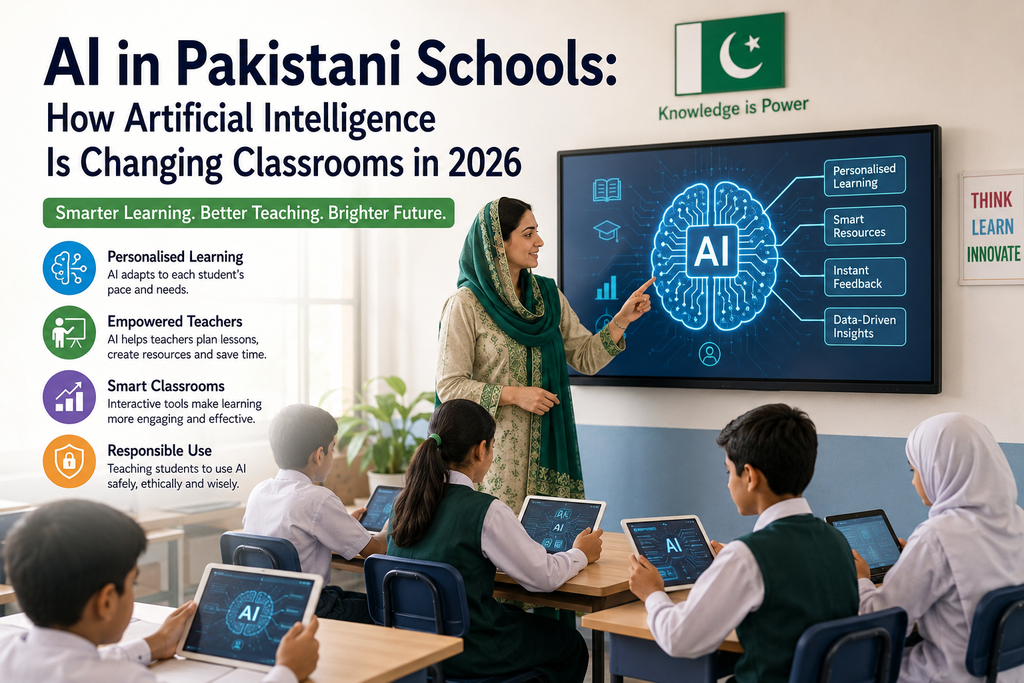
Artificial Intelligence (AI) is no longer a technology limited to scientists, engineers, and technology companies. In 2026, AI is becoming an increasingly important part of everyday life, and education is one of the areas where its impact is becoming particularly significant.
For Pakistani schools, the growth of AI brings both opportunities and challenges. Artificial Intelligence can help teachers prepare lessons, support students, personalise learning, create educational resources, and develop skills needed for the future. At the same time, schools need to address issues such as teacher training, internet access, digital infrastructure, student dependence on technology, academic honesty, and responsible use of AI.
The important question is no longer whether AI will enter Pakistani classrooms. The real question is how schools can use AI effectively without losing the human element of education.
1. What Is Artificial Intelligence in Education?
Artificial Intelligence refers to computer systems that can perform tasks that normally require human intelligence. These tasks include understanding language, analysing information, recognising patterns, solving problems, generating content, and providing recommendations.
In education, AI can be used in many different ways.
For example, an AI-powered learning system may identify that a student is struggling with mathematics and provide additional practice. A teacher may use AI to generate lesson ideas, quizzes, activities, or explanations. Students may use AI tools to understand difficult concepts or practise their language skills.
AI should not be viewed as a replacement for teachers.
Instead, it should be considered a supporting technology that can help teachers teach and students learn more effectively.
2. Why AI Matters for Pakistani Schools in 2026
Pakistan has a large and young population, making education extremely important for the country’s future.
The world of work is also changing rapidly. Students entering the workforce in the coming years will need more than traditional academic knowledge. They will need digital literacy, communication skills, creativity, critical thinking, problem-solving abilities, and the ability to work with new technologies.
Artificial Intelligence is becoming part of many professional fields, including education, business, medicine, engineering, marketing, finance, design, and communication.
Schools therefore have an important responsibility: prepare students for a world in which AI will be a normal part of work and everyday life.
Teaching students about AI does not mean turning every student into a computer programmer. It means helping them understand technology and use it intelligently.
3. AI Is Changing the Role of the Teacher
One of the biggest concerns surrounding AI is whether computers will replace teachers.
A good teacher does much more than provide information.
Teachers motivate students, understand their individual needs, manage classrooms, encourage confidence, answer questions, resolve problems, build relationships, and guide students morally and socially.
These human qualities are extremely important.
AI can instead help teachers with repetitive and time-consuming tasks.
For example, teachers can use AI to:
- Generate lesson ideas
- Prepare classroom activities
- Create quizzes
- Develop practice questions
- Suggest examples
- Prepare revision material
- Create different levels of exercises
- Simplify difficult explanations
- Organise ideas for lessons
- Develop discussion questions
This can give teachers more time to focus on students.
The future classroom should therefore not be teacher versus AI.
It should be teacher plus AI.
4. Personalised Learning for Students
Every student learns differently.
Some students understand a concept quickly, while others need more examples and practice. Some students learn better through visual materials, while others prefer reading, listening, or practical activities.
Traditional classrooms can make it difficult for one teacher to provide completely individualised instruction to every student.
AI has the potential to support personalised learning.
For example, imagine three students learning fractions.
Student A understands the basic concept and needs advanced questions.
Student B understands fractions but struggles with word problems.
Student C is still confused about the basic concept and needs simpler explanations.
An AI-supported learning system can potentially provide different exercises according to each student’s level.
The teacher can then use this information to provide targeted support.
This does not mean that every student needs an individual AI tutor. Even simple AI-supported tools can help teachers identify learning gaps and provide additional practice.
5. AI Can Help Teachers Prepare Better Lessons
Lesson planning requires considerable time and effort.
AI can assist teachers by providing a starting point for lesson preparation.
For example, a teacher teaching Grade 5 science could ask an AI tool to suggest:
- Learning objectives
- A lesson introduction
- Classroom questions
- Examples
- Group activities
- Practical experiments
- A short quiz
- Homework exercises
However, teachers should never blindly use AI-generated content.
AI can sometimes provide incorrect information or inappropriate examples.
The teacher should always review and adapt the material before using it in the classroom.
The best approach is:
AI generates ideas; the teacher makes the professional decision.
6. AI and English Language Learning
English remains an important skill for Pakistani students.
It is useful for higher education, employment, international communication, freelancing, technology, research, and many professional careers.
AI can provide students with additional opportunities to practise English.
Students can use AI-powered tools to:
- Practise conversations
- Learn new vocabulary
- Improve grammar
- Correct sentences
- Understand difficult passages
- Practise writing
- Create speaking exercises
- Receive feedback
- Learn through interactive questions
For students who cannot afford private tuition, technology can potentially provide additional learning support.
However, students should not use AI simply to complete their English assignments.
The purpose should be practice, improvement, and learning.
7. AI Can Make Learning More Interactive
Traditional classroom teaching sometimes depends heavily on textbooks, lectures, memorisation, and written exercises.
AI can help make learning more interactive.
For example, students can ask questions about a topic, explore different explanations, generate examples, solve problems, and practise concepts through interactive activities.
A science student could explore different scientific scenarios.
A history student could ask questions about historical events.
A language student could practise conversations.
A mathematics student could request additional problems at different difficulty levels.
When used appropriately, AI can encourage students to:
- Ask more questions
- Explore ideas
- Investigate problems
- Compare information
- Practise skills
- Explain their thinking
- Learn independently
This can help move education from simple memorisation toward understanding and application.
8. AI and Student Creativity
There is an ongoing concern that AI could reduce student creativity.
This can happen if students allow AI to do everything for them.
If a student asks AI to write every story, essay, project, presentation, and assignment, the student may lose opportunities to develop independent thinking.
However, AI can also be used to support creativity.
For example, a student writing a story could use AI to brainstorm possible themes and then create an original story.
An art student could explore different ideas before developing their own artwork.
A science student could ask AI to suggest possible solutions to a problem and then investigate those solutions independently.
The key principle is simple:
AI should support creativity, not replace it.
9. The Challenge of Academic Honesty
One of the biggest challenges created by AI is academic honesty.
Students can use AI tools to generate essays, solve homework questions, prepare presentations, and produce answers.
If students submit AI-generated work as their own, teachers may have difficulty understanding what students actually know.
Schools therefore need to rethink assessment methods.
Teachers can increase the use of:
- Classroom discussions
- Oral presentations
- Projects
- Practical activities
- Viva examinations
- In-class writing
- Group activities
- Problem-solving exercises
- Student portfolios
- Personal reflections
Teachers can also ask students to explain their submitted work.
If a student has genuinely understood an assignment, they should be able to explain the ideas in their own words.
10. AI Literacy Should Become a Student Skill
Students do not necessarily need advanced programming skills to understand AI.
However, every student should develop basic AI literacy.
Students should understand:
- What Artificial Intelligence is
- How AI tools are used
- What AI can do
- What AI cannot do
- Why AI sometimes makes mistakes
- How to check AI-generated information
- How to write useful prompts
- How to protect personal information
- How to use AI ethically
- Why they should not become dependent on AI
These skills will become increasingly important as AI becomes part of education and employment.
11. The Digital Divide in Pakistan
One of the biggest challenges for AI education in Pakistan is unequal access to technology.
Some schools have computer laboratories, internet connections, smart boards, tablets, and digital learning resources.
Other schools may have limited access to computers, electricity, internet connectivity, or trained technology teachers.
This creates the possibility of a new educational divide.
Students in well-equipped schools may have extensive opportunities to learn and use AI, while students in under-resourced schools may have very limited access.
Therefore, successful AI education requires more than software.
Pakistan needs:
- Reliable electricity
- Internet connectivity
- Computer laboratories
- Digital devices
- Teacher training
- Technical support
- Appropriate educational software
AI education should be accessible to students from different socioeconomic backgrounds.
12. Teacher Training Must Come First
Providing schools with computers and AI software is not enough.
Teachers need training to use these technologies effectively.
A teacher should understand how to:
- Use AI tools responsibly.
- Check AI-generated information.
- Prepare AI-supported lessons.
- Teach students responsible AI use.
- Protect student privacy.
- Identify inappropriate AI-generated content.
- Prevent academic misuse.
- Integrate AI with the existing curriculum.
Teacher professional development should therefore become a central part of any AI education programme.
The success of AI in schools will depend heavily on the people using it.
A well-trained teacher with appropriate technology can achieve much more than technology without a trained teacher.
13. AI Should Not Replace Traditional Learning
There is a danger of becoming too excited about new technology.
AI is powerful, but students still need fundamental educational skills.
Children must learn:
- Reading
- Writing
- Mathematics
- Science
- Communication
- Critical thinking
- Creativity
- Discipline
- Collaboration
- Social skills
AI should strengthen these abilities rather than replace them.
A student who cannot read and understand a paragraph independently will not automatically become a better learner simply because an AI tool can summarise it.
Technology is valuable when it improves learning rather than becoming a shortcut around learning.
14. The Importance of Critical Thinking
Perhaps one of the most important skills in the AI era is critical thinking.
AI can sometimes provide answers that sound convincing but contain errors.
Students therefore need to learn how to question information.
They should ask:
Is this information correct?
What evidence supports this answer?
Can I verify it?
Does the answer make sense?
Is there another possible explanation?
This is an important change in education.
When information becomes easier to obtain, schools must place greater emphasis on understanding, evaluating, questioning, and applying information.
15. AI Can Support Students With Different Learning Needs
AI also has the potential to make education more inclusive.
Learning materials can potentially be adapted according to students’ needs.
For example, educational content may be presented through:
- Simpler language
- Step-by-step explanations
- Additional examples
- Audio
- Visual descriptions
- Extra practice
- Different difficulty levels
This can provide additional support for students who need more time or alternative explanations.
However, AI should complement teachers and educational specialists rather than replace human support.
16. What Could an AI-Enabled Pakistani Classroom Look Like?
Imagine a Pakistani classroom in the near future.
The teacher begins the lesson with a short explanation.
Students then work in groups to solve a problem.
Some students use computers or tablets to research information, while others work on practical activities.
An AI-supported learning system identifies students who are struggling with the topic.
Those students receive additional exercises.
The teacher reviews the learning information and identifies common mistakes.
The teacher then explains the difficult concept again.
Students discuss the topic, complete an activity, and finally take a short assessment.
In this classroom, AI does not replace the teacher.
Instead, AI provides additional support while the teacher remains responsible for instruction, guidance, discipline, assessment, and student development.
17. AI in Primary Schools
Introducing AI to young children does not mean teaching them advanced programming.
Primary students can learn basic concepts through simple activities.
For example, teachers can introduce questions such as:
- What is a computer?
- What is a machine?
- What is data?
- How do computers recognise patterns?
- Can computers make mistakes?
- How can technology help people?
- Why should we check information?
- How should we behave online?
Children can learn these concepts through:
- Stories
- Games
- Puzzles
- Simple coding activities
- Classroom discussions
- Educational videos
- Problem-solving exercises
The objective at the primary level should be understanding technology rather than mastering complicated technical concepts.
18. The Role of Parents
Parents also have an important role in helping children use AI responsibly.
Completely banning AI may not be the best long-term solution.
Instead, parents can teach children how to use technology wisely.
Parents can ask questions such as:
What did you use AI for?
What did you learn from it?
Did you check whether the information was correct?
Can you explain the answer yourself?
Did you create this work yourself?
These questions encourage children to become responsible technology users.
The goal should not be to create fear of AI.
The goal should be to develop responsible digital citizens.
19. What Should Pakistani Schools Do Now?
Schools do not need to wait for a perfect AI laboratory before introducing AI literacy.
They can begin with simple and practical steps.
Step 1: Train Teachers
Provide teachers with basic AI awareness and practical training.
Step 2: Develop an AI Policy
Schools should clearly explain when and how students are allowed to use AI.
Step 3: Teach AI Literacy
Introduce age-appropriate AI concepts into existing subjects.
Step 4: Improve Assessment
Use projects, presentations, discussions, practical work, and in-class activities.
Step 5: Protect Student Privacy
Students should be taught not to share sensitive personal information with AI tools.
Step 6: Start Small
Schools can begin with selected teachers, classes, or activities before expanding.
Step 7: Evaluate Results
The success of AI should be measured by improved learning—not simply by the number of computers or AI tools installed.
20. The Future of AI in Pakistani Education
The coming years could be extremely important for Pakistan’s education system.
AI has the potential to support personalised learning, improve teacher productivity, increase access to educational resources, and help students develop future-oriented skills.
However, technology alone cannot solve Pakistan’s educational challenges.
AI cannot replace a good teacher.
It cannot automatically solve poor infrastructure.
It cannot substitute for effective school leadership.
It cannot replace a strong curriculum.
And it cannot guarantee that students will learn.
Successful AI integration requires a combination of:
- Qualified teachers
- Strong school leadership
- Reliable infrastructure
- Appropriate curriculum
- Teacher professional development
- Responsible technology use
- Student participation
- Parent awareness
- Continuous evaluation
Conclusion
Artificial Intelligence is changing education, and Pakistani schools cannot afford to ignore this transformation.
However, the objective should not be to introduce AI simply because it is modern or fashionable.
The objective should be to use AI where it genuinely improves teaching and learning.
Teachers should remain at the heart of education.
AI can become a powerful assistant.
Students should remain thinkers, creators, problem-solvers, and independent learners.
Schools should prepare students not only to use AI, but also to understand it, question it, verify it, and use it responsibly.
The future will need people who can work alongside technology while maintaining creativity, judgement, communication skills, empathy, and critical thinking.
For Pakistani education, the most important question is therefore not:
“Will AI change our schools?”
It is:
“Are we preparing our teachers and students to use AI intelligently, ethically, and effectively?”
The schools that successfully combine human teaching with responsible technology will be in a much stronger position to prepare their students for the opportunities and challenges of the future.