

Introduction
Bitcoin (BTC) continues to dominate headlines across the cryptocurrency industry in 2026. As the world’s first and largest cryptocurrency by market capitalization, Bitcoin remains the benchmark for the entire digital asset market. Whether prices are rising or falling, investors, institutions, and financial analysts closely monitor every move Bitcoin makes.
The current market environment has created mixed emotions among investors. Some view the recent pullback as a healthy correction and a buying opportunity, while others remain cautious due to global economic uncertainty and ongoing market volatility.
In this article, we’ll examine the current Bitcoin market situation, the factors influencing BTC prices, institutional interest, future outlook, and what investors should consider before making investment decisions.
Bitcoin’s Current Market Position
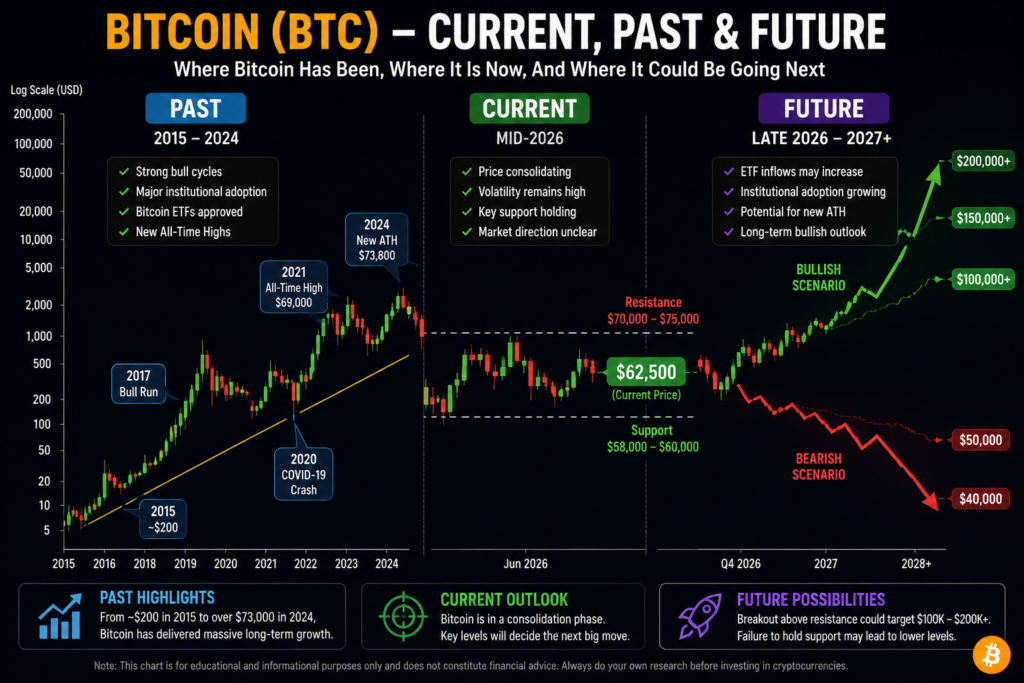
Bitcoin has experienced significant price fluctuations throughout 2026. After reaching strong highs earlier in the cycle, BTC has entered a consolidation phase that has left many traders questioning the next major move.
Price corrections are not unusual for Bitcoin. Historically, Bitcoin has gone through multiple periods of rapid growth followed by temporary declines. These corrections often shake out short-term traders while long-term investors continue accumulating positions.
Despite recent volatility, Bitcoin remains the most valuable cryptocurrency in the world and continues to attract global attention from retail and institutional investors alike.
The market is currently searching for direction as buyers and sellers compete around critical support and resistance levels.
Why Has Bitcoin Been Volatile Recently?
Several factors have contributed to Bitcoin’s recent price fluctuations.
1. Global Economic Uncertainty
Economic uncertainty remains one of the biggest influences on financial markets. Inflation concerns, central bank policies, and interest rate decisions continue to affect investor sentiment worldwide.
When investors become cautious, many reduce exposure to riskier assets, including cryptocurrencies. This can create temporary selling pressure on Bitcoin.
2. ETF Market Flows
Bitcoin Exchange-Traded Funds (ETFs) have become an important factor in determining short-term market movements.
When ETF inflows increase, Bitcoin often benefits from additional buying pressure. However, periods of ETF outflows can negatively impact market sentiment and contribute to price declines.
3. Profit Taking
Many investors who purchased Bitcoin at lower prices have chosen to secure profits during recent rallies.
Profit-taking is a natural part of every market cycle and often leads to temporary corrections before the next trend develops.
4. Geopolitical Events
Global conflicts, political uncertainty, and international economic developments can influence investor behavior.
Whenever uncertainty rises, market volatility often increases across stocks, commodities, and cryptocurrencies.
Institutional Adoption Continues to Grow
One of the strongest arguments supporting Bitcoin’s long-term future is growing institutional adoption.
A decade ago, Bitcoin was largely viewed as a speculative asset. Today, major corporations, investment funds, banks, and asset managers have entered the cryptocurrency market.
Institutional investors bring:
- Increased market credibility
- Greater liquidity
- Long-term capital
- Improved market infrastructure
Many financial institutions now offer Bitcoin-related investment products to their clients, helping expand access to digital assets.
This growing institutional participation has become one of the most important drivers of Bitcoin’s long-term growth story.
Bitcoin’s Role as Digital Gold
Many investors now view Bitcoin as “digital gold.”
Gold has historically been used as a store of value during times of economic uncertainty. Bitcoin shares several characteristics that support this comparison:
Limited Supply
Bitcoin has a maximum supply of 21 million coins.
Unlike traditional currencies, governments cannot print additional Bitcoin. This scarcity is one of its most attractive features.
Decentralization
Bitcoin operates without central authority control.
Its decentralized nature appeals to investors seeking alternatives to traditional financial systems.
Global Accessibility
Anyone with internet access can participate in the Bitcoin network.
This global accessibility has helped drive adoption across developed and emerging markets.
The Impact of Bitcoin Halving
Bitcoin’s economic model includes an event known as the “halving.”
Approximately every four years, the reward given to Bitcoin miners is reduced by 50%.
Historically, Bitcoin halvings have played an important role in long-term price appreciation because they reduce the rate at which new Bitcoin enters circulation.
Previous halving cycles have often been followed by significant bull markets, although past performance never guarantees future results.
Many investors believe the effects of the most recent halving may continue influencing Bitcoin prices throughout 2026 and beyond.
Is Bitcoin Still a Good Investment?
This remains one of the most searched questions online.
The answer depends largely on an investor’s goals, risk tolerance, and time horizon.
Reasons Investors Remain Bullish
- Growing institutional adoption
- Limited supply of 21 million coins
- Increasing global awareness
- Development of Bitcoin ETFs
- Strong long-term historical performance
Risks Investors Should Consider
- High volatility
- Regulatory uncertainty
- Market sentiment changes
- Macroeconomic pressures
- Competition from other digital assets
Investors should understand that Bitcoin remains a high-risk asset and price swings can occur quickly.
Common Strategies Used by Bitcoin Investors
Dollar-Cost Averaging (DCA)
Many long-term investors use Dollar-Cost Averaging.
Instead of investing a large amount at once, they buy Bitcoin regularly over time regardless of price fluctuations.
Benefits include:
- Reduced emotional decision-making
- Lower timing risk
- Consistent investment approach
Long-Term Holding
Many Bitcoin supporters adopt a long-term strategy.
Rather than focusing on short-term price movements, they hold Bitcoin for several years while expecting future adoption growth.
Portfolio Diversification
Experienced investors often avoid placing all capital into a single asset.
Diversification helps reduce overall investment risk.
Bitcoin Price Predictions for the Future
Predicting Bitcoin’s future price with certainty is impossible.
However, analysts continue to debate a wide range of potential outcomes.
Some experts believe Bitcoin could reach new all-time highs if:
- Institutional adoption accelerates
- ETF demand increases
- Global liquidity improves
- Regulatory clarity expands
Others remain cautious due to economic uncertainty and the possibility of further market corrections.
The truth is that Bitcoin’s future will likely depend on a combination of technology adoption, investor sentiment, economic conditions, and regulatory developments.
What New Investors Should Know
For newcomers entering the cryptocurrency market, education is essential.
Before investing in Bitcoin:
Learn the Basics
Understand how Bitcoin works, how wallets function, and how cryptocurrency exchanges operate.
Invest Responsibly
Only invest money you can afford to leave invested for an extended period.
Avoid Emotional Trading
Fear and greed are responsible for many poor investment decisions.
Focus on Security
Use trusted exchanges, strong passwords, and secure storage methods.
Protecting your assets should always be a top priority.
Final Thoughts
Bitcoin continues to stand at the center of the cryptocurrency revolution. While short-term price movements remain uncertain, its long-term significance within the global financial system continues to grow.
The current market environment reflects a combination of opportunity and caution. Institutional adoption, limited supply, and increasing awareness support Bitcoin’s long-term potential. At the same time, investors must remain aware of volatility, regulatory developments, and broader economic conditions.
Whether Bitcoin enters another major bull run or experiences additional consolidation, it remains one of the most influential financial innovations of the modern era.
For investors willing to approach the market with patience, discipline, and proper risk management, Bitcoin will likely remain an asset worth watching closely in 2026 and beyond.