

Introduction
The rise of decentralized finance (DeFi) has transformed the cryptocurrency landscape, creating new opportunities for investors to earn passive income from their digital assets. Among the most popular strategies are yield farming and staking. Both methods allow crypto holders to generate rewards without actively trading, but they differ significantly in terms of risk, complexity, returns, and investment requirements.
For beginners and experienced investors alike, understanding the differences between yield farming and staking is essential before committing funds. This guide explores how each strategy works, their advantages and disadvantages, potential risks, and which option may be best suited to your investment goals.
What Is Staking?
Staking is the process of locking cryptocurrency in a blockchain network to help validate transactions and secure the network. In return, participants receive rewards, usually in the form of additional tokens.
Staking is primarily associated with Proof-of-Stake (PoS) blockchains such as Ethereum, Solana, Cardano, Avalanche, and Polkadot.
How Staking Works
When users stake their crypto assets, they contribute to network security and consensus operations. Validators process transactions and create new blocks. The network rewards validators and delegators with newly minted coins and transaction fees.
For example:
- Stake Ethereum (ETH) on the Ethereum network
- Lock Cardano (ADA) in a staking pool
- Delegate Solana (SOL) to a validator
The rewards are distributed periodically based on the amount staked and network conditions.
Benefits of Staking
1. Simplicity
Staking is generally beginner-friendly. Many exchanges and wallets offer one-click staking options.
2. Predictable Returns
Most staking platforms provide estimated annual percentage yields (APY), allowing investors to forecast earnings more accurately.
3. Network Security
Stakers contribute directly to blockchain security and decentralization.
4. Lower Risk Compared to Yield Farming
Staking typically involves fewer smart contracts and less exposure to market volatility than yield farming.
Risks of Staking
- Token price fluctuations
- Lock-up periods restricting withdrawals
- Validator penalties (slashing)
- Reduced rewards during network changes
- https://afmnews.net/defi-explained-from-beginner-to-advanced-the-complete-guide-to-decentralized-finance/
What Is Yield Farming?
Yield farming is a DeFi strategy where users provide liquidity to decentralized protocols in exchange for rewards. Investors deposit crypto assets into liquidity pools that facilitate lending, borrowing, and decentralized trading.
In return, participants earn:
- Trading fees
- Protocol incentives
- Governance tokens
- Additional yield rewards
Yield farming became extremely popular during the DeFi boom and remains one of the highest-yielding opportunities in cryptocurrency.
How Yield Farming Works
A user deposits two or more cryptocurrencies into a liquidity pool on a decentralized exchange (DEX) or lending platform.
Examples include:
- Providing ETH and USDC liquidity
- Depositing stablecoins into lending protocols
- Participating in liquidity mining campaigns
The protocol uses these funds to support trading and lending activities while distributing rewards to liquidity providers.
Benefits of Yield Farming
1. Higher Potential Returns
Yield farming often offers significantly higher APYs than staking, particularly during incentive programs.
2. Multiple Income Sources
Farmers can earn rewards from:
- Trading fees
- Interest payments
- Governance tokens
- Bonus incentives
3. Capital Efficiency
Many advanced DeFi users maximize returns through leveraged yield farming strategies.
4. Access to Emerging Projects
Yield farming allows investors to gain exposure to new DeFi ecosystems and token launches.
Risks of Yield Farming
Impermanent Loss
Liquidity providers may experience losses when token prices change significantly relative to each other.
Smart Contract Vulnerabilities
Bugs or exploits in DeFi protocols can result in substantial losses.
Market Volatility
High-yield pools often involve volatile cryptocurrencies.
Rug Pulls and Scams
New or unaudited projects may pose significant security risks.
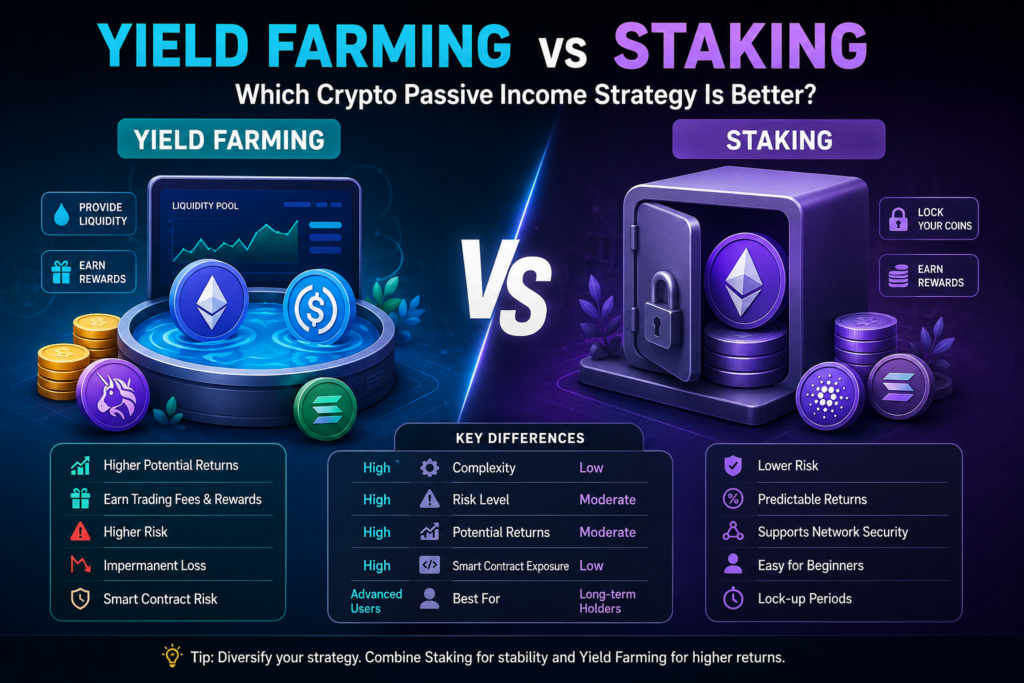
Yield Farming vs Staking: Key Differences
| Feature | Staking | Yield Farming |
|---|---|---|
| Complexity | Low | Medium to High |
| Risk Level | Moderate | High |
| Potential Returns | Moderate | High |
| Technical Knowledge | Minimal | Advanced |
| Smart Contract Exposure | Limited | Extensive |
| Capital Requirement | Flexible | Often Higher |
| Lock-up Periods | Common | Usually Flexible |
| Passive Income Stability | More Stable | Variable |
The primary distinction lies in risk and reward. Staking offers greater simplicity and stability, while yield farming provides higher earning potential at the cost of increased complexity and risk.
Which Generates Higher Returns?
Yield farming generally offers higher annual percentage yields than staking.
Typical staking rewards:
- Ethereum: 3%–6% APY
- Cardano: 3%–5% APY
- Solana: 5%–8% APY
Typical yield farming rewards:
- Stablecoin pools: 5%–20% APY
- Liquidity mining programs: 20%–100%+ APY
- Emerging DeFi projects: Potentially several hundred percent APY
However, higher returns usually indicate higher risk. Investors should evaluate whether the additional yield adequately compensates for potential losses.
Security Comparison
Staking Security
Staking is generally considered safer because:
- It relies on established blockchain networks
- Fewer smart contracts are involved
- Major staking providers undergo regular audits
Yield Farming Security
Yield farming carries additional security concerns:
- Smart contract exploits
- Protocol failures
- Oracle manipulation attacks
- Liquidity pool vulnerabilities
Before participating in any farming protocol, investors should verify:
- Audit reports
- Team transparency
- Total value locked (TVL)
- Community reputation
Security should always take priority over high advertised yields.
Best Use Cases for Staking
Staking is ideal for investors who:
- Prefer long-term crypto holdings
- Want predictable passive income
- Have limited DeFi experience
- Prioritize security over maximum returns
- Support blockchain network participation
Popular staking assets include:
- Ethereum
- Solana
- Cardano
- Polkadot
Best Use Cases for Yield Farming
Yield farming may be suitable for investors who:
- Understand DeFi protocols
- Actively monitor investments
- Seek higher returns
- Diversify across multiple platforms
- Accept greater levels of risk
Popular DeFi ecosystems include:
- Uniswap
- Aave
- Curve Finance
- PancakeSwap
Can You Combine Yield Farming and Staking?
Yes. Many investors use a hybrid strategy.
For example:
- Allocate 70% of crypto holdings to staking for stable returns.
- Allocate 30% to carefully selected yield farming opportunities.
- Regularly rebalance the portfolio based on market conditions.
This approach balances risk and reward while maintaining exposure to high-growth DeFi opportunities.
Tax Considerations
In many jurisdictions, staking rewards and yield farming income may be taxable events. Investors should:
- Maintain detailed transaction records
- Track reward distributions
- Monitor capital gains obligations
- Consult a qualified tax professional
Tax regulations vary significantly by country and continue to evolve as governments develop cryptocurrency frameworks.
Future Outlook for Yield Farming and Staking
As blockchain technology matures, both staking and yield farming are expected to remain essential components of the crypto economy.
Emerging trends include:
- Liquid staking derivatives
- Restaking protocols
- Cross-chain liquidity farming
- AI-powered yield optimization
- Institutional DeFi participation
- Enhanced security standards
These innovations may improve accessibility, efficiency, and returns for crypto investors in the coming years.
Conclusion
When comparing yield farming vs staking, neither strategy is universally superior. The right choice depends on your experience level, risk tolerance, and investment objectives.
Staking offers a simpler and safer method for generating passive income while supporting blockchain networks. It is ideal for long-term investors seeking consistent rewards with lower risk.
Yield farming, on the other hand, provides significantly higher earning potential but comes with greater complexity and exposure to smart contract, liquidity, and market risks.
For most beginners, staking serves as an excellent starting point. Experienced DeFi participants may choose yield farming to maximize returns while carefully managing risk. A balanced combination of both strategies can often provide the optimal mix of stability and growth in a diversified cryptocurrency portfolio.