

Introduction
The cryptocurrency market is known for its volatility and sensitivity to global events. Among the many factors that influence digital assets, geopolitical conflicts often have a significant impact on investor behavior and market performance. One of the most closely watched conflicts in recent years has been the ongoing tensions and military confrontations between Iran and Israel. As two influential nations in the Middle East, any escalation between them creates uncertainty across global financial markets, including cryptocurrencies.
The Iran–Israel conflict affects more than regional politics. It influences oil prices, investor sentiment, inflation expectations, and global economic stability. Because cryptocurrencies operate in a highly interconnected financial environment, they often react quickly to such developments. This article examines how the Iran–Israel war impacts the crypto market and compares the performance of cryptocurrencies with traditional assets such as gold and stocks during periods of geopolitical uncertainty.https://bestreview.id/2026/05/30/wavlink-4-port-hdmi-splitter-review-expand-your-workspace-with-quad-monitor-4k-support/
Understanding the Relationship Between War and Financial Markets
Wars and geopolitical tensions create uncertainty. Investors generally dislike uncertainty because it makes future economic conditions difficult to predict. When military conflicts escalate, investors often move their funds away from risky assets and toward safer investments.
Traditionally, assets such as gold, government bonds, and stable currencies benefit during times of conflict. These assets are considered safe havens because they tend to preserve value even during economic turmoil. Cryptocurrencies, however, occupy a unique position. Some investors view Bitcoin as “digital gold,” while others still consider it a speculative risk asset.
The Iran–Israel conflict provides an excellent case study for understanding how cryptocurrencies behave during periods of international instability.
Immediate Impact on the Cryptocurrency Market
Increased Market Volatility
One of the most noticeable effects of geopolitical conflict is increased volatility. Whenever news of military strikes, political threats, or regional escalation emerges, cryptocurrency prices often react within minutes.
Unlike stock markets, which operate during specific hours, crypto markets trade 24 hours a day, seven days a week. This continuous trading environment means that geopolitical developments are reflected almost instantly in cryptocurrency prices.
Bitcoin, Ethereum, and major altcoins frequently experience sharp price swings following significant developments in the Iran–Israel conflict. Investors rush to adjust their positions, leading to sudden increases in trading volume and price fluctuations.
Panic Selling and Risk Reduction
During the initial stages of a conflict, many investors choose to reduce their exposure to risky assets. Since cryptocurrencies are generally considered higher-risk investments, they often experience selling pressure.
This panic selling can trigger substantial declines in market value. Traders using leverage are particularly vulnerable because falling prices can activate automatic liquidations, further accelerating market declines.
As fear spreads through the market, even strong projects with solid fundamentals may experience short-term price drops simply because investors are seeking safety.
Rise in Stablecoin Demand
While many cryptocurrencies suffer during periods of uncertainty, stablecoins often experience increased demand. Stablecoins are digital assets designed to maintain a stable value, usually pegged to the US dollar.
Investors frequently move funds from volatile cryptocurrencies into stablecoins to protect their capital while remaining within the crypto ecosystem. This behavior allows them to avoid large losses while maintaining flexibility to re-enter the market when conditions improve.
The Effect of Rising Oil Prices
One of the most significant economic consequences of the Iran–Israel conflict is its impact on global oil markets.
The Middle East is responsible for a large portion of the world’s oil production and transportation. Any threat to supply routes or production facilities can cause oil prices to rise sharply. Higher oil prices increase transportation and manufacturing costs worldwide, contributing to inflation.
Inflation affects cryptocurrencies indirectly. When inflation rises, central banks may maintain higher interest rates for longer periods. Higher interest rates reduce liquidity in financial markets and make speculative investments less attractive.
As a result, cryptocurrency markets often face additional pressure during periods of rising oil prices and inflation concerns.https://afmnews.net/weekly-crypto-news-market-analysis/
Bitcoin: Safe Haven or Risk Asset?
The debate over Bitcoin’s role during geopolitical crises remains ongoing.
Arguments Supporting Bitcoin as a Safe Haven
Supporters of Bitcoin argue that it possesses characteristics similar to gold:
- Limited supply of 21 million coins
- Decentralized structure
- Independence from government control
- Resistance to censorship
- Global accessibility
These features make Bitcoin attractive to investors seeking alternatives to traditional financial systems during periods of political instability.
Some investors view Bitcoin as a long-term hedge against inflation, currency devaluation, and economic uncertainty.
Arguments Against Bitcoin as a Safe Haven
Critics point out that Bitcoin remains highly volatile compared to traditional safe-haven assets. During major geopolitical events, Bitcoin often declines alongside stocks rather than behaving like gold.
Its relatively short history, speculative trading activity, and sensitivity to investor sentiment make it difficult to classify as a true safe-haven asset.
In many cases, Bitcoin initially falls during crises before recovering later, suggesting that it still behaves more like a risk asset in the short term.
Comparison: Cryptocurrency vs Gold
Gold has been a trusted store of value for thousands of years. During periods of war and uncertainty, investors typically increase their allocation to gold.
Gold’s Advantages
- Long-established safe-haven status
- Lower volatility
- Strong historical performance during crises
- Broad acceptance among institutional investors
Cryptocurrency’s Advantages
- Easy global transferability
- Limited supply in the case of Bitcoin
- High liquidity
- Accessibility without traditional banking systems
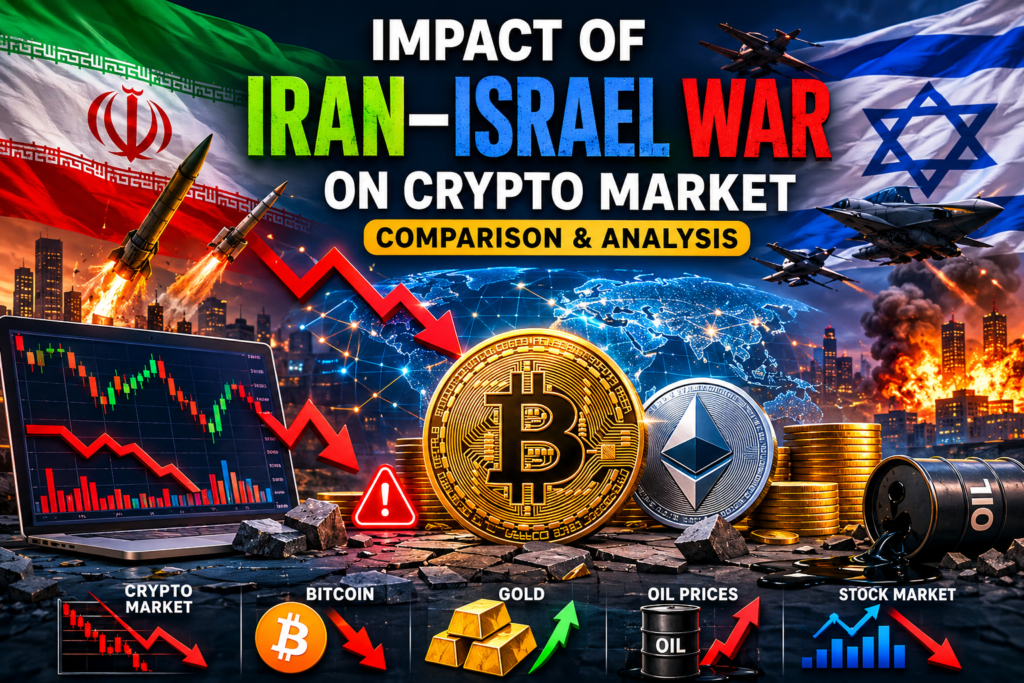
During the Iran–Israel conflict, gold has generally demonstrated greater stability than cryptocurrencies. However, cryptocurrencies often recover more rapidly after the initial market shock subsides.
This difference highlights the contrasting nature of the two asset classes. Gold focuses on capital preservation, while cryptocurrencies offer both risk and growth potential.
Comparison: Cryptocurrency vs Stock Markets
Stock markets also react strongly to geopolitical events. However, their behavior differs from cryptocurrencies in several ways.
Similarities
Both stocks and cryptocurrencies often decline during periods of heightened geopolitical tension. Investor fear and uncertainty affect both markets.
Differences
Cryptocurrencies tend to be:
- More volatile
- Faster to react to news
- More influenced by retail investors
- Open for trading around the clock
Stocks, on the other hand, are generally:
- More regulated
- Supported by corporate earnings
- Influenced by institutional investors
- Restricted to exchange trading hours
The Iran–Israel conflict has shown that cryptocurrencies can experience larger percentage movements than stock markets over short periods. While this creates opportunities for traders, it also increases risk.
Long-Term Implications for Cryptocurrency Adoption
Although wars often create short-term market disruptions, they can also contribute to long-term cryptocurrency adoption.
Growing Interest in Decentralized Finance
Geopolitical instability highlights the vulnerabilities of traditional financial systems. In regions affected by sanctions, banking restrictions, or currency instability, cryptocurrencies can provide alternative financial solutions.
This increased awareness may encourage broader adoption of decentralized financial technologies.
Increased Demand for Borderless Transactions
Cryptocurrencies enable fast and borderless transactions. During periods of conflict, individuals and businesses may seek alternative payment methods that are not dependent on traditional banking infrastructure.
Expansion of Stablecoin Usage
Stablecoins continue to play an increasingly important role during uncertain times. Their ability to combine the speed of blockchain technology with the stability of traditional currencies makes them attractive to both individuals and institutions.
What Investors Can Learn
The Iran–Israel conflict demonstrates that geopolitical events can significantly influence cryptocurrency markets. Investors should recognize that digital assets are not immune to global developments.
Several key lessons emerge:
- Geopolitical risks can trigger short-term market volatility.
- Diversification remains essential during uncertain times.
- Emotional decision-making often leads to poor investment outcomes.
- Long-term investors should focus on fundamentals rather than short-term headlines.
- Risk management becomes especially important during periods of conflict.
Understanding these principles can help investors navigate volatile market conditions more effectively.https://afmnews.net/top-5-mistakes-new-crypto-investors-make-and-how-to-avoid-them/
Conclusion
The Iran–Israel war has highlighted the complex relationship between geopolitical events and cryptocurrency markets. While cryptocurrencies offer unique advantages such as decentralization, global accessibility, and independence from traditional financial systems, they remain vulnerable to investor fear and market uncertainty.
In the short term, military conflicts often trigger volatility, panic selling, and capital flight toward traditional safe-haven assets like gold. Rising oil prices and inflation concerns can further pressure digital asset markets.
However, the long-term outlook presents a different picture. Increased interest in decentralized finance, borderless transactions, and financial independence may ultimately strengthen cryptocurrency adoption worldwide. Bitcoin continues to evolve as a potential store of value, although it has not yet fully achieved the stability associated with traditional safe-haven assets.
As global tensions continue to shape financial markets, the cryptocurrency sector will remain an important area to watch. The Iran–Israel conflict serves as a reminder that while cryptocurrencies are transforming finance, they are still deeply connected to the broader economic and geopolitical landscape.