

Introduction
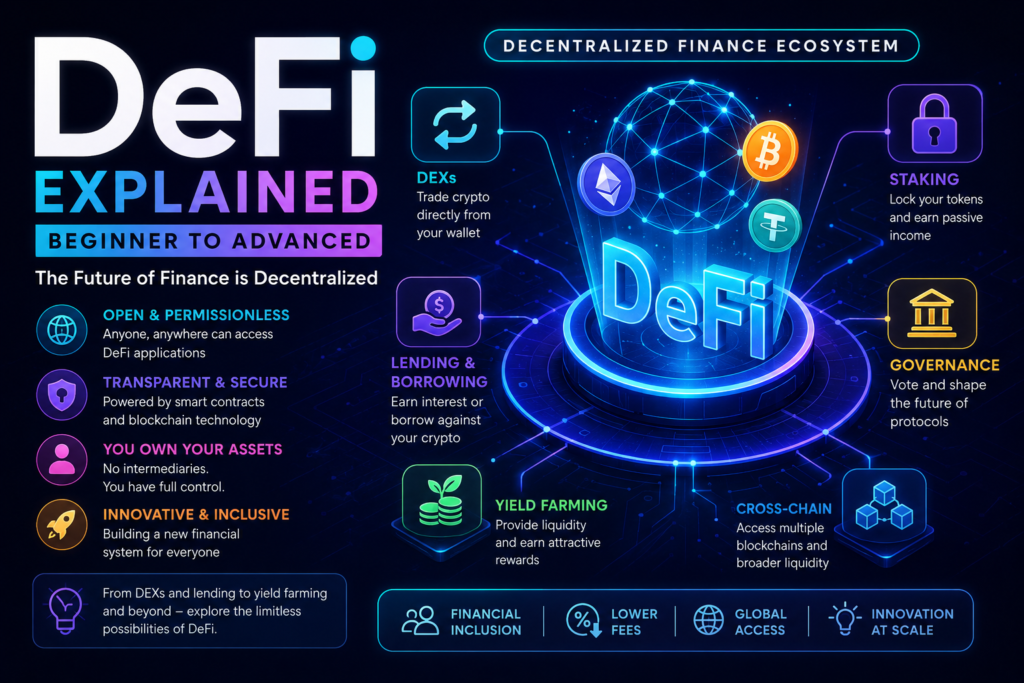
The financial world is undergoing a major transformation, and at the center of this revolution is Decentralized Finance (DeFi). Built on blockchain technology, DeFi aims to recreate traditional financial services without relying on banks, brokers, or other centralized institutions. Instead, it uses smart contracts and decentralized networks to provide financial products that are transparent, accessible, and efficient.
Over the last few years, DeFi has grown from a niche concept into a multi-billion-dollar ecosystem. From lending and borrowing to trading, staking, and yield farming, DeFi offers opportunities that were previously unavailable to many people around the world. Whether you are completely new to cryptocurrency or an experienced investor looking to deepen your understanding, this guide will take you from the basics of DeFi to advanced concepts shaping the future of finance.https://afmnews.net/top-altcoins-under-1-to-watch-in-2026/
What is DeFi?
Decentralized Finance (DeFi) refers to a collection of blockchain-based financial applications that operate without traditional intermediaries. Instead of trusting a bank to hold your money or process transactions, DeFi relies on smart contracts—self-executing pieces of code that automatically enforce agreements.
Most DeFi applications are built on the Ethereum blockchain, although other networks such as Binance Smart Chain, Solana, Avalanche, and Polygon also support thriving DeFi ecosystems.
Key Characteristics of DeFi
- Decentralization: No central authority controls the platform.
- Transparency: All transactions are recorded on public blockchains.
- Permissionless Access: Anyone with an internet connection and crypto wallet can participate.
- Programmability: Smart contracts automate financial processes.
- Interoperability: Different DeFi applications can work together seamlessly.
These characteristics make DeFi a compelling alternative to traditional finance for many users worldwide.
How Does DeFi Work?
At the core of DeFi are smart contracts. These digital agreements execute automatically when predefined conditions are met.
For example, in a traditional loan:
- A bank evaluates your creditworthiness.
- The bank approves or rejects your application.
- The bank manages repayments.
In DeFi:
- You provide cryptocurrency as collateral.
- A smart contract automatically issues the loan.
- Repayments and collateral management occur through code.
This automation eliminates intermediaries, reducing costs and increasing efficiency.
Essential Components of DeFi
Blockchain Networks
Blockchains provide the infrastructure that powers decentralized applications.
Popular DeFi blockchains include:
- Ethereum
- BNB Chain
- Solana
- Polygon
- Avalanche
- Arbitrum
Smart Contracts
These programmable contracts execute transactions automatically without human intervention.
Crypto Wallets
Users access DeFi platforms through wallets such as MetaMask, Trust Wallet, Rabby, or Phantom.
Tokens
Most DeFi ecosystems use cryptocurrencies and tokens for governance, payments, rewards, and liquidity provision.
Major DeFi Applications
1. Decentralized Exchanges (DEXs)
DEXs allow users to trade cryptocurrencies directly from their wallets without centralized exchanges.
Popular examples include:
- Uniswap
- PancakeSwap
- SushiSwap
- Raydium
Benefits of DEXs
- Non-custodial trading
- Enhanced privacy
- Global accessibility
- Reduced dependence on centralized entities
DEXs use liquidity pools instead of traditional order books, enabling seamless trading through automated market makers (AMMs).
2. Lending and Borrowing Platforms
One of the most popular DeFi use cases is decentralized lending.
Users can:
- Deposit crypto assets
- Earn interest
- Borrow against collateral
Popular lending platforms include:
- Aave
- Compound
- Venus
- Morpho
How It Works
Suppose you own Bitcoin but need cash. Instead of selling your Bitcoin, you can deposit it as collateral and borrow stablecoins against it.
This allows investors to maintain market exposure while accessing liquidity.
3. Stablecoins
Stablecoins are cryptocurrencies designed to maintain a stable value.
Common stablecoins include:
- USDT
- USDC
- DAI
- FDUSD
Why Stablecoins Matter
They reduce volatility and make DeFi applications more practical for:
- Payments
- Lending
- Savings
- Trading
Without stablecoins, DeFi would struggle to support many financial activities.
4. Yield Farming
Yield farming involves providing liquidity to DeFi protocols in exchange for rewards.
Users deposit tokens into liquidity pools and receive:
- Trading fees
- Protocol incentives
- Governance tokens
Advantages
- Passive income opportunities
- Enhanced capital efficiency
- Participation in protocol growth
However, yield farming carries risks such as impermanent loss and smart contract vulnerabilities.
5. Staking
Staking allows users to lock cryptocurrencies to support network operations and earn rewards.
Benefits include:
- Regular passive income
- Network security support
- Lower complexity than yield farming
Popular staking assets include Ethereum, Solana, Cardano, and various proof-of-stake tokens.
Benefits of DeFi
Financial Inclusion
Millions of people worldwide lack access to traditional banking services. DeFi only requires:
- Internet access
- A compatible crypto wallet
This opens financial opportunities to underserved populations.
Greater Transparency
Every transaction can be verified on-chain, reducing the opacity often associated with traditional financial institutions.
Reduced Costs
By removing intermediaries, DeFi can lower fees associated with:
- Transfers
- Loans
- Trading
- Investments
Full Asset Control
Users maintain ownership of their funds through self-custody wallets rather than entrusting assets to third parties.
Innovation and Accessibility
New financial products can be launched quickly without lengthy approval processes, fostering rapid innovation.
Risks and Challenges of DeFi
While DeFi offers exciting opportunities, investors should understand the associated risks.
Smart Contract Vulnerabilities
Coding errors can result in:
- Exploits
- Hacks
- Loss of funds
Even audited protocols are not completely risk-free.
Market Volatility
Cryptocurrency prices can fluctuate dramatically, impacting collateral values and investment returns.
Impermanent Loss
Liquidity providers may experience losses when token prices change significantly relative to each other.
Regulatory Uncertainty
Governments worldwide continue developing regulations for cryptocurrency and decentralized finance.
Future policy changes could impact DeFi platforms and users.
User Responsibility
In DeFi, users are responsible for:
- Private keys
- Wallet security
- Transaction verification
Mistakes can be irreversible.
Advanced DeFi Concepts
Liquidity Pools
Liquidity pools are collections of funds deposited by users to facilitate decentralized trading.
Participants earn a share of trading fees generated within the pool.
These pools are fundamental to modern decentralized exchanges.
Automated Market Makers (AMMs)
AMMs replace traditional buyers and sellers with mathematical algorithms.
Instead of matching orders, prices are determined automatically using formulas based on pool balances.
Benefits include:
- Continuous liquidity
- Efficient trading
- Decentralized execution
Governance Tokens
Many DeFi protocols issue governance tokens that grant voting rights.
Token holders can influence:
- Fee structures
- Protocol upgrades
- Treasury management
- Strategic decisions
Examples include UNI, AAVE, and COMP.
Cross-Chain DeFi
As blockchain ecosystems expand, interoperability becomes increasingly important.
Cross-chain solutions allow users to:
- Transfer assets between networks
- Access broader liquidity
- Reduce transaction costs
This trend is expected to accelerate as multi-chain adoption grows.
Real-World Asset Tokenization
One of the most promising developments in DeFi is tokenization.
Real-world assets such as:
- Real estate
- Bonds
- Stocks
- Commodities
can be represented digitally on blockchain networks.
Benefits include:
- Fractional ownership
- Increased liquidity
- Global accessibility
- Enhanced transparency
Many experts believe tokenization could become a major driver of future DeFi growth.
The Future of DeFi
The next phase of DeFi is likely to focus on scalability, security, regulation, and mainstream adoption.
Emerging trends include:
Institutional Participation
Large financial institutions are increasingly exploring blockchain-based financial products.
AI Integration
Artificial intelligence may improve:
- Risk assessment
- Portfolio optimization
- Automated trading strategies
Layer-2 Scaling Solutions
Technologies such as rollups help reduce fees and improve transaction speeds.
Improved User Experience
Future platforms aim to make DeFi as simple as traditional online banking while preserving decentralization.
Tokenized Global Finance
The convergence of traditional finance and blockchain technology could create a more accessible and efficient financial system.
Conclusion
Decentralized Finance is redefining how people interact with money, investments, lending, and financial services. By leveraging blockchain technology and smart contracts, DeFi removes intermediaries and empowers users with greater control over their assets.
For beginners, DeFi offers an accessible entry point into modern financial innovation through wallets, stablecoins, staking, and decentralized exchanges. For advanced users, opportunities extend into yield farming, liquidity provision, governance participation, cross-chain ecosystems, and tokenized real-world assets.
Although risks remain—including smart contract vulnerabilities, market volatility, and regulatory uncertainty—the potential benefits of transparency, accessibility, and financial inclusion continue to drive rapid adoption worldwide. As blockchain technology matures and user-friendly solutions emerge, DeFi is positioned to become a foundational pillar of the future global financial system.
Whether you are an investor, trader, developer, or curious learner, understanding DeFi today may help you navigate the next generation of digital finance tomorrow.https://afmnews.net/web3-explained-a-simple-beginners-guide-to-the-future-of-the-internet/