

Blockchain technology has become one of the most talked-about innovations of the digital era. From powering cryptocurrencies like Bitcoin to transforming industries such as finance, healthcare, and education, blockchain is reshaping how data is stored, verified, and shared. In this detailed guide, you’ll learn what blockchain technology is, how it works, its key features, benefits, real-world uses, and why it matters in 2026 and beyond.
What is Blockchain Technology?
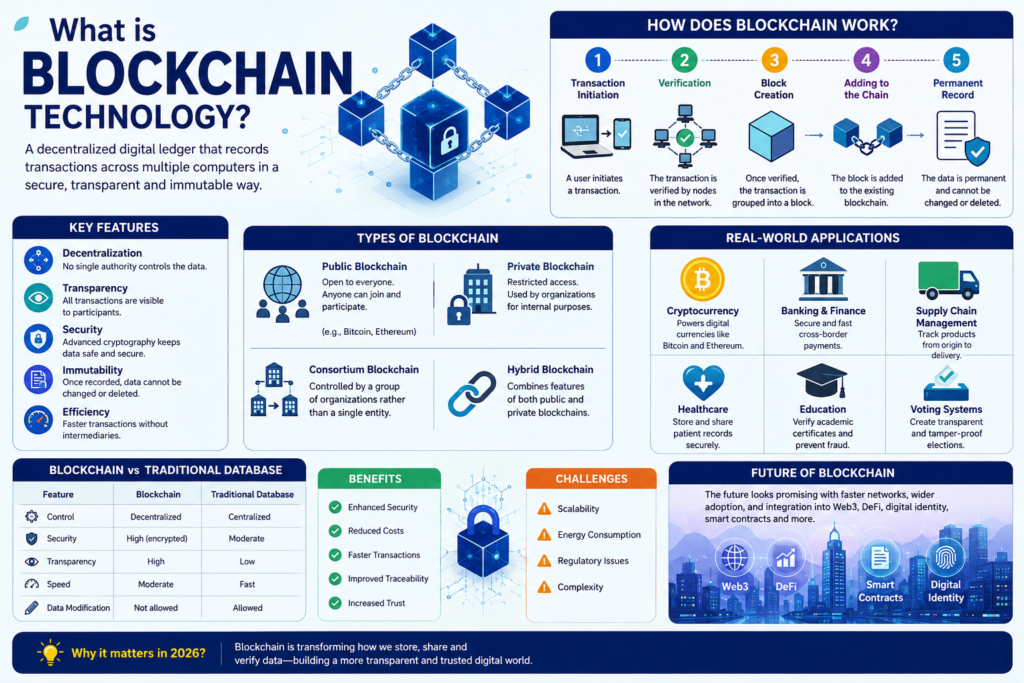
Blockchain is a decentralized digital ledger that records transactions across multiple computers in a secure and transparent way. Instead of relying on a central authority (like a bank or government), blockchain distributes data across a network, making it nearly impossible to alter or hack.
Each record in blockchain is called a block, and these blocks are linked together in a chain—hence the name “blockchain.”
How Does Blockchain Work?
To understand blockchain simply, imagine a digital notebook shared among thousands of people. Every time a new transaction happens, it is recorded in that notebook, and everyone gets a copy.
Here’s how the process works step-by-step:https://afmnews.net/how-to-start-crypto-trading-in-pakistan-beginners-complete-guide/
1. Transaction Initiation
A user initiates a transaction (for example, sending cryptocurrency or recording data).
2. Verification
The transaction is verified by a network of computers called nodes. These nodes check whether the transaction is valid.
3. Block Creation
Once verified, the transaction is grouped with others into a block.
4. Adding to the Chain
The block is added to the existing blockchain in chronological order.
5. Permanent Record
Once added, the data cannot be changed, making it secure and tamper-proof.
Key Features of Blockchain Technology
1. Decentralization
Blockchain does not rely on a single authority. Data is distributed across many nodes, reducing the risk of control or failure.
2. Transparency
All transactions are visible to participants, making the system open and trustworthy.
3. Security
Blockchain uses advanced cryptography to secure data, making hacking extremely difficult.
4. Immutability
Once data is recorded, it cannot be changed or deleted.
5. Efficiency
Transactions can be processed faster without intermediaries like banks.
Types of Blockchain
1. Public Blockchain
Open to everyone. Anyone can join and participate (e.g., Bitcoin, Ethereum).
2. Private Blockchain
Restricted access. Used by organizations for internal purposes.
3. Consortium Blockchain
Controlled by a group of organizations rather than a single entity.
4. Hybrid Blockchain
Combines features of both public and private blockchains.
Benefits of Blockchain Technology
1. Enhanced Security
Because data is encrypted and decentralized, blockchain offers high-level security.
2. Reduced Costs
No need for intermediaries like banks or brokers, reducing transaction fees.
3. Faster Transactions
Transactions can be completed in minutes instead of days.
4. Improved Traceability
Every transaction is recorded, making it easy to trace and verify.
5. Increased Trust
Transparency builds trust among users without needing a third party.
Real-World Applications of Blockchain
1. Cryptocurrency
Blockchain is the backbone of digital currencies like Bitcoin and Ethereum.
2. Banking and Finance
Banks use blockchain for secure and fast cross-border payments.
3. Supply Chain Management
Companies track products from origin to delivery using blockchain.
4. Healthcare
Patient records can be stored securely and shared safely.
5. Education
Academic certificates can be verified using blockchain to prevent fraud.
6. Voting Systems
Blockchain can create transparent and tamper-proof voting systems.
Blockchain vs Traditional Databases
| Feature | Blockchain | Traditional Database |
|---|---|---|
| Control | Decentralized | Centralized |
| Security | High (encrypted) | Moderate |
| Transparency | High | Low |
| Speed | Moderate | Fast |
| Data Modification | Not allowed | Allowed |
Challenges of Blockchain Technology
While blockchain has many advantages, it also faces some challenges:
1. Scalability
Handling large numbers of transactions can be slow.
2. Energy Consumption
Some blockchains (like Bitcoin) require high energy.
3. Regulatory Issues
Laws and regulations are still evolving.
4. Complexity
Understanding and implementing blockchain can be difficult.
Future of Blockchain Technology
The future of blockchain looks promising. As technology improves, we can expect:
- Faster and more scalable blockchain networks
- Increased adoption in government and businesses
- Growth in decentralized finance (DeFi)
- Expansion into Web3 and digital identity systems
Blockchain is likely to become a core part of digital infrastructure in the coming years.
Why Blockchain Matters in 2026
In 2026, blockchain is no longer just about cryptocurrency. It is being used in:
- Digital payments and banking systems
- Secure data sharing in education and healthcare
- Smart contracts for automated agreements
- Online identity verification
Its role in improving transparency, reducing fraud, and increasing efficiency makes it a powerful technology for the future.
Low Competition SEO Keywords (Used in this Blog)
- What is blockchain technology simple explanation
- blockchain technology for beginners guide
- benefits of blockchain technology in 2026
- how blockchain works step by step
- real world applications of blockchain
- blockchain technology advantages and disadvantages
- future of blockchain technology 2026
- blockchain in education and healthcare
Conclusion
Blockchain technology is a revolutionary system that allows secure, transparent, and decentralized data management. By eliminating intermediaries and enhancing trust, it has the potential to transform industries worldwide. Whether you are a student, professional, or business owner, understanding blockchain can help you stay ahead in the digital age.https://afmnews.net/best-crypto-wallets-for-beginners-2026-guide/