

Introduction
The rapid evolution of blockchain technology, virtual reality, artificial intelligence, and decentralized finance is transforming how people interact online. At the center of this transformation are two revolutionary concepts: the Metaverse and Cryptocurrency. Together, they are creating new opportunities for digital ownership, virtual economies, online communities, and immersive experiences.
As major technology companies and blockchain projects continue investing billions into virtual worlds, many investors and technology enthusiasts are asking: What is the future of the Metaverse and Crypto?
This article explores the latest trends, growth opportunities, challenges, and predictions for the future of the Metaverse and cryptocurrency ecosystem.
https://afmnews.net/web3-explained-a-simple-beginners-guide-to-the-future-of-the-internet/
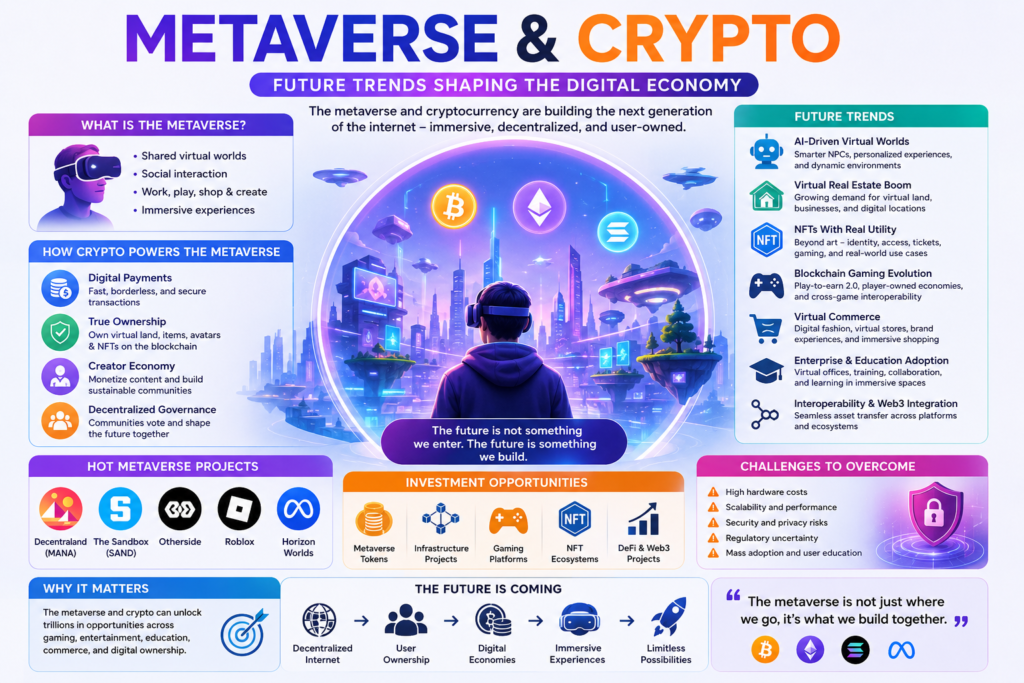
What Is the Metaverse?
The Metaverse is a shared virtual environment where users can interact, work, play, socialize, shop, and own digital assets through avatars.
Think of it as a combination of:
- Virtual Reality (VR)
- Augmented Reality (AR)
- Artificial Intelligence (AI)
- Blockchain Technology
- Social Networking
- Digital Commerce
Users can enter digital worlds, attend virtual events, purchase virtual land, and engage in immersive experiences from anywhere in the world.
How Cryptocurrency Powers the Metaverse
Cryptocurrencies serve as the financial infrastructure of virtual worlds.
They enable:
Digital Payments
Users can buy virtual goods and services instantly without traditional banks.
Ownership of Assets
Blockchain verifies ownership of:
- Virtual land
- Digital collectibles
- NFTs
- In-game items
- Digital identities
Creator Economy
Artists, developers, and content creators can monetize their work directly through blockchain-based marketplaces.
Decentralized Governance
Many metaverse projects allow communities to vote on platform decisions using governance tokens.
Why the Metaverse and Crypto Are Connected
Without cryptocurrency and blockchain, true digital ownership would be difficult to achieve.
Blockchain provides:
- Security
- Transparency
- Ownership verification
- Decentralized transactions
- Cross-platform asset transfer
This creates a foundation for virtual economies where users truly own their digital assets.
Major Metaverse Projects to Watch
Decentraland (MANA)
One of the earliest blockchain-based virtual worlds where users can purchase virtual land and build experiences.
The Sandbox (SAND)
A popular metaverse platform allowing creators to build games, experiences, and digital assets.
Otherside
Developed by Yuga Labs, Otherside combines gaming, NFTs, and virtual social experiences.
Roblox
Although not fully blockchain-based, Roblox demonstrates the enormous demand for virtual worlds and digital economies.
Horizon Worlds
Meta’s virtual reality platform focused on social interaction and immersive experiences.
Future Trends in Metaverse and Crypto
1. AI-Powered Virtual Worlds
Artificial Intelligence will make virtual environments more interactive and realistic.
Future applications include:
- Intelligent NPCs
- Personalized experiences
- AI-generated content
- Virtual assistants
- Dynamic digital environments
AI integration may significantly improve user engagement within metaverse platforms.
2. Growth of Virtual Real Estate
Virtual land continues attracting investors and businesses.
Potential uses include:
- Virtual stores
- Digital advertising
- Event venues
- Educational campuses
- Entertainment centers
As user adoption grows, premium digital locations could become increasingly valuable.
3. NFT Evolution Beyond Collectibles
NFTs are expanding beyond digital artwork.
Future NFT applications may include:
- Digital identity verification
- Event tickets
- Membership access
- Intellectual property rights
- Real estate documentation
- Gaming assets
NFT utility is expected to become more important than speculation.
4. Blockchain Gaming Expansion
Play-to-earn and own-to-earn models continue evolving.
Future blockchain games may feature:
- Player-owned economies
- Tradable assets
- Cross-game interoperability
- Decentralized governance
- AI-enhanced gameplay
Gaming remains one of the strongest adoption drivers for the metaverse.
5. Integration of Web3 Technologies
The convergence of:
- Blockchain
- Decentralized Finance (DeFi)
- NFTs
- Digital Wallets
- Smart Contracts
will strengthen metaverse ecosystems and expand their functionality.
6. Virtual Commerce and Shopping
Major brands are increasingly exploring virtual commerce opportunities.
Potential developments include:
- Virtual stores
- Digital fashion
- NFT merchandise
- Interactive product demonstrations
- Virtual customer support
Digital commerce may become a major revenue source for metaverse platforms.
7. Corporate Adoption
Large corporations are experimenting with virtual environments for:
- Employee training
- Remote collaboration
- Marketing campaigns
- Customer engagement
- Product launches
Enterprise adoption could accelerate mainstream acceptance.
8. Cross-Platform Interoperability
Future metaverse ecosystems may allow users to transfer assets between platforms.
Benefits include:
- Increased asset utility
- Larger digital economies
- Better user experience
- Enhanced liquidity
Interoperability remains a key objective for Web3 developers.
Investment Opportunities
Investors often gain exposure through:
Metaverse Tokens
Examples include:
- MANA
- SAND
- AXS
- GALA
- IMX
Infrastructure Projects
- Ethereum (ETH)
- Solana (SOL)
- Polygon (POL)
- Avalanche (AVAX)
- Chainlink (LINK)
NFT Ecosystems
Projects supporting digital ownership and creator economies.
Gaming Platforms
Blockchain gaming remains one of the fastest-growing segments of Web3.
Challenges Facing the Metaverse
Despite its potential, several obstacles remain.
High Hardware Costs
VR and AR equipment can be expensive for average consumers.
Scalability Issues
Large virtual worlds require significant computing and network resources.
Security Concerns
Users must protect wallets, assets, and personal information.
Regulatory Uncertainty
Governments continue developing frameworks for digital assets and virtual economies.
Adoption Barriers
Mainstream users may require simpler interfaces and improved accessibility.
Will the Metaverse Replace the Internet?
Most experts believe the metaverse will not replace the internet but rather become an extension of it.
Future online experiences may combine:
- Traditional websites
- Mobile applications
- Virtual environments
- Blockchain-based ownership
- AI-driven interactions
Users may seamlessly move between physical and digital worlds.
Long-Term Outlook
The combination of blockchain, AI, virtual reality, and decentralized finance creates one of the most exciting technological opportunities of the next decade.
Potential growth areas include:
- Digital ownership
- Virtual commerce
- Blockchain gaming
- Remote collaboration
- Education
- Entertainment
- Healthcare applications
- Creator economies
As infrastructure improves and adoption increases, the metaverse and cryptocurrency industries could become central components of the future digital economy.
Conclusion
The future of the Metaverse and Cryptocurrency is closely connected. Blockchain technology enables digital ownership, secure transactions, decentralized governance, and virtual economies that power immersive online worlds. Emerging trends such as AI integration, blockchain gaming, NFT utility, virtual commerce, and Web3 infrastructure are expected to drive significant growth over the coming years.
Although challenges such as regulation, scalability, and adoption remain, the long-term potential of metaverse ecosystems continues attracting developers, businesses, and investors worldwide. Understanding these trends today may help individuals and organizations prepare for the next generation of digital innovation.