

Introduction
The internet has evolved dramatically over the past three decades. From simple websites in the 1990s to social media and cloud-based applications today, technology continues to transform how we communicate, work, and conduct business. Now, a new concept called Web3 is gaining attention and is often described as the next generation of the internet.
But what exactly is Web3? Why are companies, developers, investors, and technology enthusiasts so excited about it? This simple guide explains Web3 in easy-to-understand language, even if you’re completely new to blockchain and cryptocurrency.
https://afmnews.net/ethereum-future-should-you-invest-in-ethereum-in-2026/
What Is Web3?
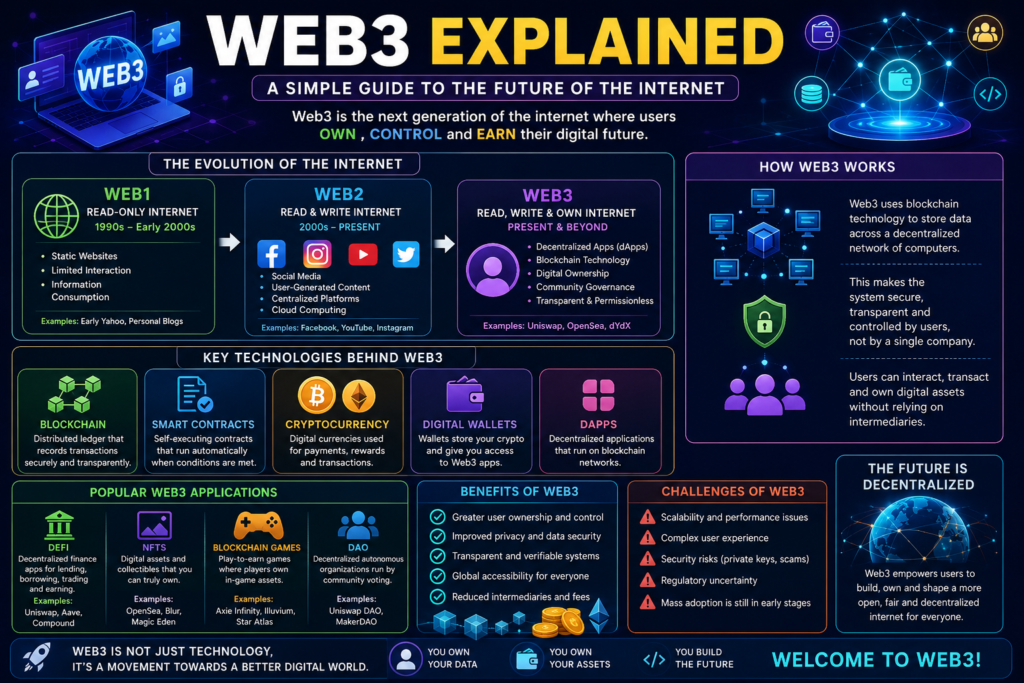
Web3 is a decentralized version of the internet where users have greater control over their data, digital assets, and online identities.
Unlike today’s internet, where large companies control platforms and user information, Web3 uses blockchain technology to distribute control among users and communities.
Simple Definition
Web3 = Internet + Blockchain + User Ownership
The goal of Web3 is to create a more open, transparent, and user-controlled digital world.
Understanding the Evolution of the Internet
Web1: Read-Only Internet (1990s–Early 2000s)
Web1 was the first generation of the internet.
Features:
- Static websites
- Limited interaction
- Information consumption only
- Personal websites and directories
Examples:
- Early Yahoo pages
- Personal blogs
- Company information websites
Users could read information but had little ability to interact.
Web2: Read and Write Internet (2000s–Present)
Web2 introduced interactive platforms and social networking.
Features:
- Social media
- User-generated content
- Mobile apps
- Cloud computing
- E-commerce
Examples:
- YouTube
- X (Twitter)
- TikTok
While Web2 created enormous opportunities, large corporations gained significant control over user data and content.
Web3: Read, Write, and Own Internet
Web3 adds ownership to the internet experience.
Features:
- Blockchain technology
- Decentralized applications (dApps)
- Cryptocurrency payments
- Digital ownership
- Smart contracts
- Community governance
Users can own digital assets instead of relying entirely on centralized platforms.
How Does Web3 Work?
Web3 relies on blockchain technology.
A blockchain is a secure digital ledger that records transactions across multiple computers instead of storing information on a single server.
Because data is distributed:
- No single company controls everything
- Records are transparent
- Transactions are secure
- Ownership can be verified
Key Technologies Behind Web3
1. Blockchain
Blockchain stores data securely and transparently.
Popular blockchains include:
- Ethereum
- Solana
- BNB Chain
- Avalanche
- Polygon
These networks support decentralized applications and digital assets.
2. Smart Contracts
Smart contracts are self-executing programs stored on blockchains.
They automatically perform actions when specific conditions are met.
Example:
A smart contract can release payment automatically after a product is delivered without requiring a bank or intermediary.
3. Cryptocurrency
Cryptocurrencies power many Web3 ecosystems.
Examples include:
- Bitcoin (BTC)
- Ethereum (ETH)
- Solana (SOL)
- BNB
- Polygon (POL)
Users can send funds globally without traditional banks.
4. Digital Wallets
A digital wallet allows users to access Web3 applications.
Popular wallets include:
- MetaMask
- Trust Wallet
- Phantom Wallet
- Coinbase Wallet
Wallets act as your identity and gateway into Web3.
What Are Decentralized Applications (dApps)?
Decentralized Applications (dApps) operate on blockchain networks rather than centralized servers.
Examples include:
Decentralized Exchanges (DEXs)
Users can trade cryptocurrencies directly without intermediaries.
Examples:
- Uniswap
- PancakeSwap
- Jupiter
Blockchain Games
Players own in-game items and can trade them freely.
Examples:
- Axie Infinity
- Illuvium
- Star Atlas
NFT Marketplaces
Users buy, sell, and own digital collectibles.
Examples:
- OpenSea
- Blur
- Magic Eden
Benefits of Web3
Greater User Ownership
Users control their digital assets and online identities.
Improved Privacy
Personal data is less dependent on centralized companies.
Global Accessibility
Anyone with internet access can participate.
Transparency
Blockchain transactions can be publicly verified.
Reduced Intermediaries
Direct peer-to-peer interactions lower costs and increase efficiency.
Challenges Facing Web3
Despite its potential, Web3 still faces obstacles.
Scalability
Some blockchains struggle to process large transaction volumes.
User Experience
Many Web3 applications remain difficult for beginners.
Security Risks
Users must protect private keys and digital wallets carefully.
Regulatory Uncertainty
Governments continue developing cryptocurrency regulations.
Adoption Barriers
Mass adoption requires simpler interfaces and broader education.
Real-World Uses of Web3
Finance (DeFi)
Users can:
- Lend assets
- Borrow funds
- Earn interest
- Trade without banks
Gaming
Players own digital items and in-game currencies.
Digital Identity
Users can verify identity without relying on centralized organizations.
Supply Chain Tracking
Blockchain improves transparency throughout manufacturing and shipping.
Creator Economy
Artists and creators can monetize content directly through NFTs and decentralized platforms.
Why Investors Are Interested in Web3
Many investors believe Web3 could become a multi-trillion-dollar industry because it combines:
- Blockchain technology
- Artificial Intelligence
- Digital ownership
- Decentralized finance
- Gaming
- Metaverse applications
As adoption grows, infrastructure projects supporting Web3 may experience significant growth.
Popular Web3 Projects
Some notable Web3 ecosystems include:
- Ethereum (ETH)
- Solana (SOL)
- Polygon (POL)
- Chainlink (LINK)
- Arbitrum (ARB)
- Optimism (OP)
- Avalanche (AVAX)
These projects provide infrastructure for decentralized applications and services.
The Future of Web3
The future of Web3 depends on technological innovation, regulation, and user adoption. Many experts believe decentralized systems will increasingly integrate with traditional industries such as finance, healthcare, education, entertainment, and e-commerce.
Although challenges remain, Web3 continues attracting developers, entrepreneurs, corporations, and investors worldwide.
Conclusion
Web3 represents the next evolution of the internet by combining blockchain technology, digital ownership, smart contracts, and decentralized applications. Unlike traditional Web2 platforms that rely heavily on centralized companies, Web3 gives users greater control over their data, assets, and online experiences.
While still in its early stages, Web3 has the potential to reshape finance, gaming, digital identity, content creation, and many other industries. Understanding Web3 today can help individuals prepare for the rapidly changing digital economy of tomorrow.https://afmnews.net/top-altcoins-under-1-to-watch-in-2026/