

What Is XRP?
XRP is a digital currency created to make international payments faster, cheaper, and more efficient. It runs on the XRP Ledger, which can process transactions in just a few seconds with very low fees. Unlike Bitcoin, XRP does not rely on mining. All XRP coins were created at the start, making transactions faster and more energy-efficient.
XRP is mainly designed to help banks, payment providers, and financial institutions move money across borders without delays.
Why Is XRP Different From Other Cryptocurrencies?
XRP stands out because it focuses on real-world financial use, not just trading. Key differences include:
- Very fast transaction speed (seconds)
- Extremely low transaction fees
- Designed for global payments and remittances
- No mining required
- Strong focus on institutional adoption
These features make XRP attractive for long-term utility rather than short-term hype.
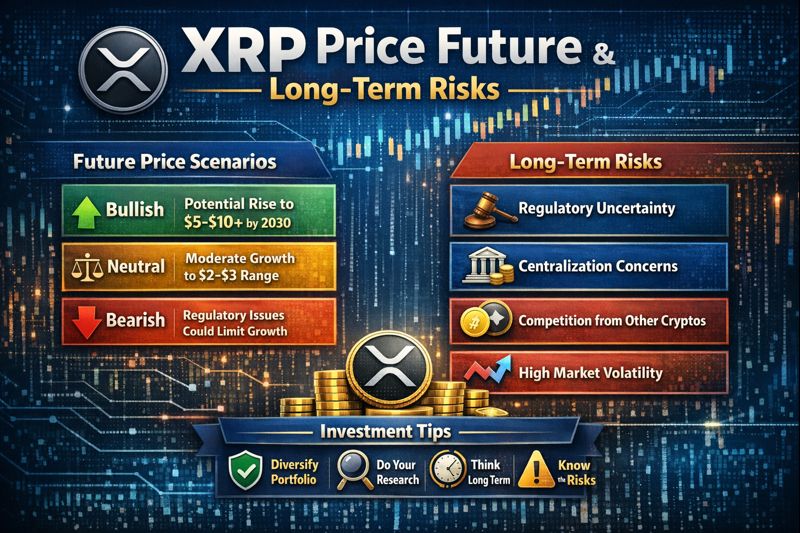
XRP Future Price Outlook
Predicting crypto prices is never guaranteed, but XRP’s future depends on adoption, regulation, and market conditions.
Positive Price Scenario
If XRP continues to be adopted by banks and payment companies, its value could rise steadily over the coming years. Increased use in cross-border payments and improved global regulations may support long-term price growth. In a strong market cycle, XRP could see significant gains.
Moderate Growth Scenario
In a balanced scenario, XRP may grow slowly but consistently. Prices could move up with the overall crypto market while remaining stable due to its utility-focused design.
Negative Scenario
If adoption slows, competition increases, or regulations become stricter, XRP’s price could remain flat or fall. Crypto markets are highly sensitive to news and global economic conditions.
Factors That Can Increase XRP’s Value
- Growing use in international money transfers
- Better global crypto regulations
- Increased trust from financial institutions
- Expansion of the XRP Ledger ecosystem
- Overall growth of the crypto market
These factors together could positively influence XRP’s long-term performance.
Risks of Holding XRP Long Term
1. Regulatory Risk
XRP has faced legal and regulatory challenges in the past. Future regulations could impact its price, usage, or availability on exchanges.
2. Centralization Concerns
A large amount of XRP is controlled by its founding company. Some investors see this as a risk because it may affect supply and market balance.
3. Market Volatility
Like all cryptocurrencies, XRP’s price can rise or fall sharply. Long-term holders must be prepared for sudden price swings.
4. Competition
XRP competes with other blockchain payment solutions, stablecoins, and traditional banking systems. New technologies could reduce its market share.
5. Adoption Uncertainty
Even strong technology does not guarantee success. If financial institutions choose other solutions, XRP’s growth could slow.
Is XRP a Good Long-Term Investment?
XRP can be a good option for investors who believe in blockchain-based global payments and are comfortable with risk. However, it should not be the only asset in a portfolio. Diversification is important to reduce losses if the market turns negative.
XRP is better suited for investors with patience and a long-term mindset, rather than those looking for quick profits.
Conclusion
XRP has strong technology and a clear real-world use case, which gives it long-term potential. However, risks such as regulation, competition, and market volatility cannot be ignored. While XRP may offer solid growth opportunities in the future, it also requires careful risk management.
If you decide to hold XRP long term, focus on research, diversification, and realistic expectations rather than hype or short-term price predictions.