

Alpha, in the context of investing, is the excess return of an investment relative to the return of a benchmark index. Essentially, it’s the skill-based return generated by an active manager or a trading strategy, beyond what you’d expect from market movements alone. A positive alpha indicates that the investment has outperformed its benchmark, while a negative alpha means it has underperformed.
What is Alpha and Why is it Attractive?
Imagine the stock market is like a flowing river. Most investments are carried along by the current, rising and falling with the general market tide (beta). Alpha is like having a special motor on your boat that allows you to move faster or in a different direction than the current, achieving returns independent of the river’s flow.
The allure of alpha trading is the promise of generating superior returns regardless of whether the overall market is going up or down. For beginners, this can seem like a powerful way to beat the market. However, identifying and consistently generating alpha is incredibly challenging.
The Challenges of Pursuing Alpha for Beginners
While attractive, alpha trading is notoriously difficult, particularly for those new to the financial markets. Here’s why:
- Complexity: Alpha strategies often involve sophisticated financial models, quantitative analysis, and a deep understanding of market inefficiencies.
- Data Requirements: Identifying alpha typically requires extensive access to historical data, real-time feeds, and the tools to process it effectively.
- High Transaction Costs: Active trading strategies designed to capture alpha can lead to frequent buying and selling, incurring significant transaction fees that eat into profits.
- Risk Management: Without proper risk management techniques, a few wrong trades can wipe out significant capital. Beginners often underestimate the importance of robust risk management.
- Competition: The market for alpha is highly competitive, with institutional investors, hedge funds, and sophisticated traders all vying for the same opportunities.
- Behavioral Biases: Emotional decision-making, such as fear and greed, can easily derail alpha-seeking strategies for inexperienced traders.
Different Approaches to Alpha Generation
Alpha can be pursued through various methods. For beginners, understanding these different approaches is a good starting point, even if implementing them is advanced:
- Fundamental Analysis: This involves researching a company’s financial statements, management, industry, and economic conditions to determine its intrinsic value. If the market price is below the intrinsic value, a trader might buy, expecting the price to rise (value investing).
- Technical Analysis: This approach uses historical price data and volume to identify patterns and predict future price movements. Indicators like moving averages, RSI, and MACD are common tools.
- Quantitative Strategies: These rely on mathematical models and algorithms to identify trading opportunities. This can involve statistical arbitrage, high-frequency trading, or factor-based investing.
- Event-Driven Strategies: These exploit mispricings that occur around corporate events like mergers, acquisitions, bankruptcies, or earnings announcements.
A Realistic Approach for Beginners
For beginners, directly engaging in complex alpha-generating strategies is generally not recommended. A more realistic and beneficial approach involves:
- Education First: Invest heavily in understanding market fundamentals, financial instruments, risk management, and basic trading principles.
- Start with Index Funds/ETFs: These passively track a market index, providing market returns (beta) with low fees and diversification. This is an excellent way to gain exposure to the market without needing to generate alpha.
- Paper Trading: Practice trading with virtual money to test strategies and understand market dynamics without risking real capital.
- Focus on Long-Term Investing: For most beginners, a long-term, diversified investment strategy focused on compounding returns is far more beneficial than trying to actively trade for alpha.
- Understand Your Risk Tolerance: Be honest about how much risk you are comfortable taking. Alpha strategies often involve higher risk.
The Concept of Alpha and Beta
To further illustrate the concept, consider the diagram below. The market return (beta) is the general upward trend, while alpha is the additional return generated above or below this market trend.
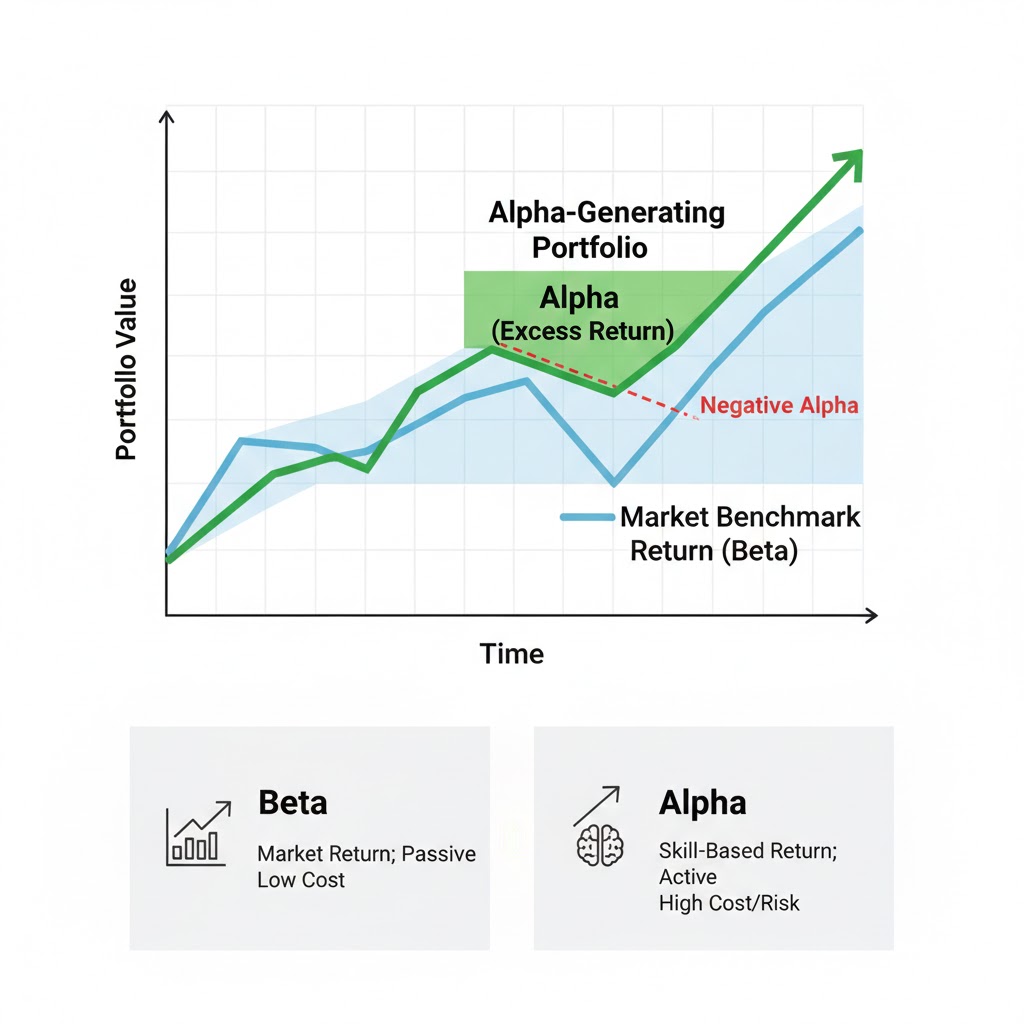
In the diagram:
- The blue line represents the market benchmark return (Beta). This is the return you’d expect from simply investing in a broad market index.
- The green line represents an alpha-generating portfolio. When the green line is above the blue line, the portfolio is generating positive alpha (excess return). The shaded green area highlights this positive alpha.
- The dashed red line illustrates a period of negative alpha, where the alpha-generating portfolio underperforms the market benchmark.
Conclusion: Is Alpha Trading Beneficial for Beginners?
In short, direct alpha trading is generally not beneficial for beginners due to its complexity, high risks, and intense competition. While the concept of alpha is fundamental to understanding active investment management, beginners are much better served by focusing on education, starting with passive investments, practicing with paper trading, and developing a solid understanding of risk management.
As you gain experience and knowledge, you can gradually explore more sophisticated strategies. Remember, consistent long-term returns are often achieved through discipline, diversification, and a clear understanding of your investment goals, rather than chasing elusive alpha from day one.